

I’ve been making beaded jewelry for sale in a local gift shop, and I’ve recently discovered that the customers also seem to like the labels I’ve designed. What I can’t quite understand is just what factors are at play in a successful business identity. I’ve decided to build my identity based on my label design, and I’d very much like to avoid the pitfalls that can destroy a business. Angela Lantain
[Posted at 1:15 pm on August 21, 2008 by Angela]

Hi Angela, There’s very little in design that can “destroy” an established business. Poor design can, however, keep a new business from getting traction. A design can be misleading. It can be inappropriate. It can be sentimental or corny or otherwise cloying. It can be amateurish. And so on. The design you want is the design that expresses unambiguously who you are, beautifully, simply, clearly.Your project sounds interesting. Show us more.John McWade
[Posted at 1:30 pm on August, 2008 by John]
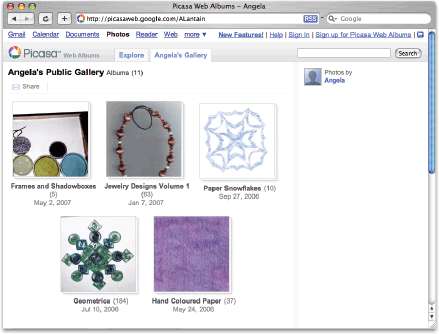
I’ve attached a copy of the file containing my business cards and labels. The labels, I have to admit, look kind of weird at first sight, but there’s a reason for that. My retailer requested that I make two separate labels—a price tag that could easily be removed and reused, and a label showing my logo and the name of the product line.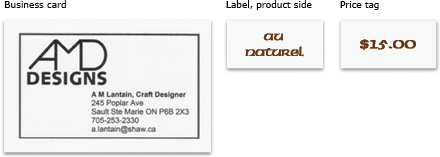 I also thought you might be interested in seeing photos of my completed projects. You can find them in my public Web albums on Picasa.Angela
[Posted at 5:40 pm on August 21, 2008 by Angela]
Hello John, An idea occurred to me this weekend. Would you be interested in a project to build the identity of a crafting business right from the ground floor? I’m sure that I’m not the only artist/crafter who is confused about how to convey a creative yet professional identity. I’d love to see what a designer could come up with. Except for my logo, I don’t really have a design in mind, so it’s a “catch as catch can” sort of project.
[Posted at 1:02 pm on August 25, 2008 by Angela]
Hi Angela, Thanks, but no, I have a magazine to publish. That said, I spent some time on your Web gallery, and I must say that your stuff is beautiful! I mean really. So my question — somewhat rhetorical — is, why do you think you need a logotype?Why would you need this . . .
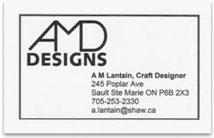
. . . when you have this? . . .
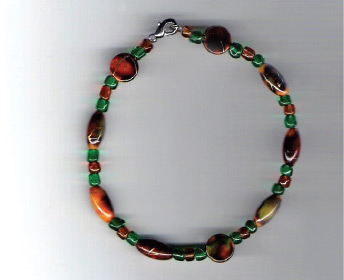
I can’t think of one reason.
Your art pieces are beautiful. They’re imaginative, professional, and—especially valuable—yours alone. No logo can give you all that. A logo will only put distance between you and your customer that’s not there now.
On top of that, what’s your goal? It’s to get your name—that is, your work and reputation—out there and make sales.
So if I were you, I’d put my art pieces right on my business cards.
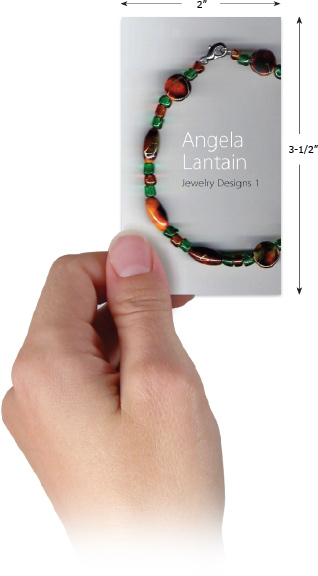
Here are four business cards . . .
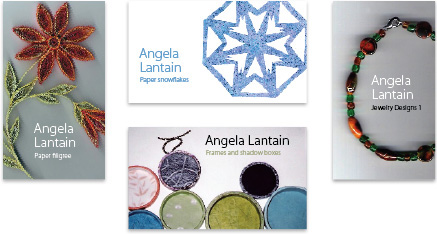
The cards are easy to make. Each has a photo of a product, plus your name in a clear typeface (Myriad), plus in smaller type the name of the product line. On the back would be your contact information. They would be easy to print on your desktop in small, gift-shop quantities. More conveniently, have moo.com print some card packs for you, and leave a pack on display for shoppers to take.
When I showed these mockups around the office, the response was, “Ooooohh, those [pieces] are beautiful. Whose are they?” (or some variation of this) And people instinctively reached towards them. I mean they physically reached out.
No logo will do that. When your stuff is so appealing that strangers want to touch a mere image, well, I’d say you’re pretty close to business-card perfection!
Try it.
John
P.S.: You need better photos. It says a lot about your pieces that their beauty shows through anyway.
[Posted at 5:48 pm on August 26, 2008 by John]
Hello John, I think that would be a great idea! I can’t believe that I never thought of that myself, though I did give some thought to putting my artwork on my cheques.I’m so grateful for your opinion about my work and the image I’m trying to project; without a formal education in graphic design or fine arts, I have to rely on my pieces to speak for themselves. I agree that I’m going to need better photos – especially if they’re going to be published. A digital camera is a definitely a must-have for artists and crafters, and it’s currently on my wish list.Angela Lantain
[Posted at 5:35 pm on August 27, 2008 by Angela]
Hi Angela, For Web work and desktop output, a $200 point-and-shoot camera is just fine. Two or three megapixels are plenty. For book-quality photos, you should have an SLR camera. I can recommend the Nikon D40, which on Amazon is about $500 with its standard lens. It’s excellent.Buy a small tripod. You can probably find one for $25 at Target.Turn off the flash.
Shoot against a solid, not patterned, background. White or neutral is best. I suggest shooting an entire collection on the same background. This can vary. Your artistic eye will know best.
Whenever possible, shoot in soft, ambient outdoor light, the kind you’d get through a north-facing window. Avoid direct sun, which makes harsh shadows. Avoid artificial light if you can.
If you must shoot in artificial light, set your camera to “fluorescent” or “incandescent” or whatever you’re using. This will help keep the colors true.
Pose your piece against its background. Set your camera on its tripod. Make sure it’s focusing on your piece. Steady finger, then shoot. If you’re indoors at night, the no-flash exposure will be too long to hold your finger steady, so set the camera’s automatic timer, and let it take its own picture. An SLR camera will come with a remote shutter release.
You’ll do great.
John
[Posted at 6:18 pm on August 27, 2008 by John]
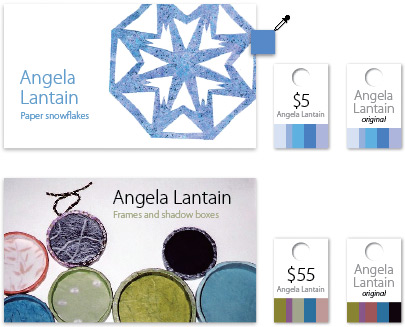
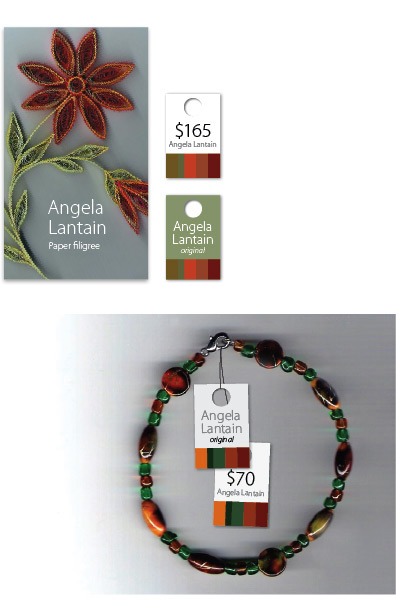
Hi Angela, You still need the price tags and labels that your retailer wanted, so here’s a suggestion that’s easy to do. Each art piece gets two tags—one price and one label. Size is 3/4″ x 1-1/4″, give or take. The tag with the price gets removed. The other says “Angela Lantain original” and remains with the piece when it’s sold.Along the edge of each tag is a tiny palette of colors that are eyedroppered from the art piece. The colors are unique to the individual piece. If two dozen pieces are on display, the customer will see two dozen different color palettes, but otherwise the tags look alike. It makes a distinctive Lantain “brand,” and you can print them yourself—at least until you’re rich and famous!See what you think.
John
[Posted at 4:46 pm on September 12, 2008 by John]
Hi John, The pictures look just great! I especially like the colour palette idea; customers would be better able to choose suitable colours for frames and mats to display the pieces. Thanks for all your help!Angela
[Posted at 5:41 pm on September 12, 2008 by Angela]
For more on logo and business card design, we recommend the following print issues:


